


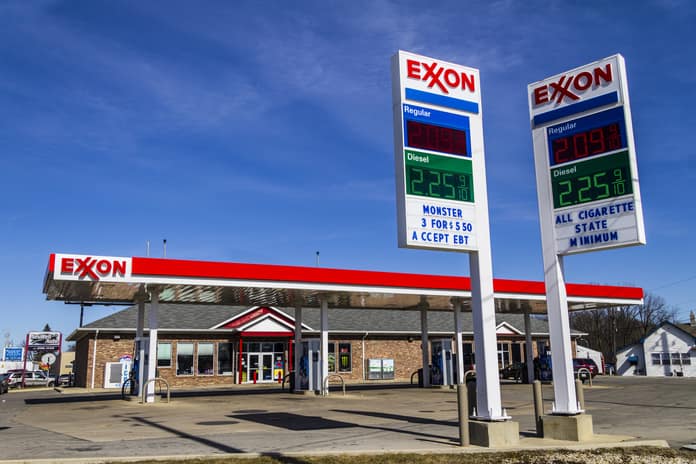
The ExxonMobil stock valuation has become a hot topic for investors looking at large-cap energy names. Exxon Mobil Corporation (NYSE:XOM) currently trades at a higher multiple than many of its integrated oil and gas peers, raising a key question: should investors be willing to pay a premium for this energy giant, or is caution warranted at current levels?
On a trailing 12-month basis, ExxonMobil stock trades at roughly 7.7 times enterprise value to EBITDA, well above the broader industry average. This also puts it at a premium to peers such as BP plc (NYSE:BP) and Eni SpA (NYSE:E), both of which trade at notably lower valuation multiples. At first glance, this gap may look concerning. However, valuation alone rarely tells the full story.
Why ExxonMobil Stock Commands a Higher Valuation
A major reason behind the higher ExxonMobil stock valuation lies in the quality of its upstream assets. ExxonMobil has built an enviable footprint in two of the most attractive oil and gas regions in the world: the Permian Basin in the United States and offshore Guyana.
In the Permian, ExxonMobil has focused on operational efficiency and technology. The company has adopted lightweight proppant techniques that have improved well recoveries by as much as 20%. These productivity gains help lower breakeven costs and boost margins, even when oil prices soften.
Guyana is another standout. Multiple discoveries and rising production volumes have turned the region into one of ExxonMobil’s most important growth engines. Crucially, production in Guyana is low-cost, giving the company resilience during periods of weaker crude prices. Together, the Permian and Guyana support ExxonMobil’s long-term production outlook and help explain why investors assign a premium valuation.
Production Growth and Long-Term Visibility
ExxonMobil’s corporate plan adds further support to its ExxonMobil stock valuation. Management expects total upstream production to rise to about 5.5 million barrels of oil equivalent per day by the end of the decade. Around 65% of that output is expected to come from its most advantaged assets, including the Permian, Guyana, and liquefied natural gas projects.
This level of visibility is rare in the energy sector, which is often characterized by volatile prices and uncertain investment returns. Investors tend to reward companies that can grow production without significantly increasing capital spending, and ExxonMobil believes it can do exactly that.
Refining Strength and Disciplined Spending
Another pillar supporting the ExxonMobil stock valuation is the company’s resilient downstream and refining operations. When oil prices fall and upstream earnings come under pressure, refining often provides a buffer.
ExxonMobil has highlighted how its facilities, including upgrades in Singapore, allow the company to turn lower-value fuels into higher-value products that meet demand for cleaner fuels. This flexibility helps stabilize cash flows across commodity cycles.
At the same time, ExxonMobil has maintained a conservative capital expenditure strategy. Management expects earnings and cash flow growth without a major increase in spending, a discipline that many investors view favorably after years of boom-and-bust cycles in the energy industry.
Returns on Capital and Shareholder Rewards
ExxonMobil also stands out for its focus on returns. The company targets a return on capital employed above 17% by the end of the decade, a strong figure for an integrated energy major. This efficiency supports both reinvestment and shareholder distributions.
From an income perspective, ExxonMobil is one of the largest dividend payers in the S&P 500. It has increased its dividend for more than 40 consecutive years and continues to execute a sizable share buyback program. These factors contribute to investor confidence and help justify a higher ExxonMobil stock valuation relative to peers.
Reasons for Caution
Despite these strengths, investors should not ignore the risks. ExxonMobil still generates a large share of its earnings from upstream operations, which are closely tied to oil prices. Forecasts from the U.S. Energy Information Administration suggest that crude prices could trend lower over the next couple of years due to rising global inventories.
If oil prices remain under pressure, even ExxonMobil’s high-quality assets may not fully offset weaker commodity pricing. This is an important consideration for new investors evaluating whether to buy at a premium valuation.
Bottom Line for Investors
In summary, the ExxonMobil stock valuation reflects strong assets, disciplined execution, and reliable shareholder returns. While the premium compared with BP (NYSE:BP) and Eni (NYSE:E) may give some investors pause, it is supported by ExxonMobil’s balance sheet strength, production growth, and capital discipline.
For new investors, patience may be prudent given oil price uncertainty. However, long-term holders may find that ExxonMobil’s fundamentals continue to justify its place as a core energy holding rather than a stock to abandon solely on valuation concerns.
Featured Image: Megapixl ©Jetcityimage