

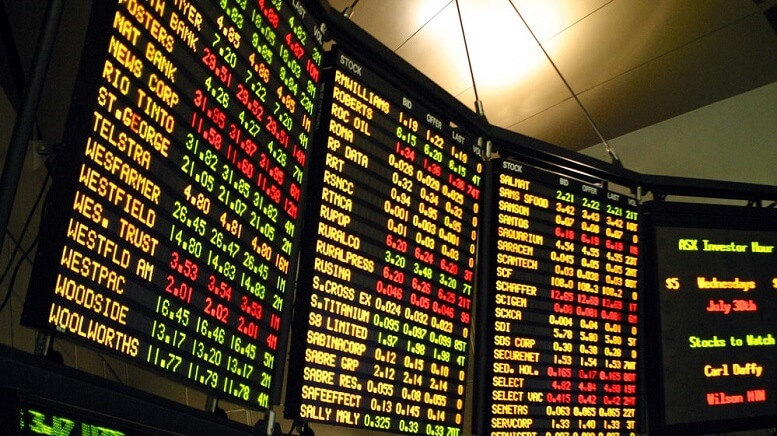
Stocks on Wall Street fell sharply Monday after Federal Reserve Chair Jerome Powell revealed that the Department of Justice had served the central bank with subpoenas and threatened a criminal indictment related to his testimony on Fed building renovations. The S&P 500 ($SPX) declined 0.3% in early trading, while the Dow Jones Industrial Average ($DJIA) lost 384 points, or 0.8%, and the Nasdaq composite ($COMP) slipped 0.2%. Powell called the threat of criminal charges “pretexts” aimed at undermining the Fed’s independence in setting interest rates, a critical tool for managing inflation.
U.S. Futures React to Fed Tensions
Ahead of the opening bell, U.S. futures also reflected investor unease. S&P 500 futures fell 0.5%, Dow futures dropped 0.7%, and Nasdaq futures slid 0.8%. The market reaction comes amid a renewed conflict between President Donald Trump and the Fed. Trump has criticized a $2.5 billion renovation of two Fed buildings, calling it excessive, while repeatedly pressuring Powell to lower interest rates faster than the central bank’s current trajectory.
In a Sunday interview with NBC News, Trump claimed he was unaware of the investigation into Powell, adding that he would not intentionally pressure the Fed regarding interest rates. However, the political tension alone was enough to rattle markets, with investors concerned about the independence of the Fed and the potential implications for borrowing costs, including mortgages and consumer loans.
Banking Sector Bears the Brunt
Bank and credit card stocks were among the hardest hit during premarket trading. Capital One Financial (NASDAQ:COF) and Synchrony (NYSE:SYF) each fell more than 8%, while Visa (NYSE:V) and Mastercard (NYSE:MA) retreated roughly 2%. Major U.S. banks also posted losses: Wells Fargo (NYSE:WFC) and Bank of America (NYSE:BAC) slid nearly 2%, JPMorgan Chase (NYSE:JPM) fell 2.8%, and Citigroup (NYSE:C) dropped 4%.
Trump suggested a potential one-year cap of 10% on credit card interest rates, which could affect profitability for banks and credit card companies. It remains unclear whether this cap would be implemented through executive action or legislation, though the announcement alone prompted investor caution. The banking sector is expected to face strong opposition from Wall Street and credit card companies, many of which were major donors to Trump’s 2024 campaign.
Energy Stocks See Mixed Reactions
In the energy sector, investor attention turned to Trump’s comments on U.S. oil giants. He expressed skepticism over ExxonMobil’s (NYSE:XOM) efforts in Venezuela following political instability, stating that the company was “playing too cute.” Shares of ExxonMobil edged slightly lower, while Chevron (NYSE:CVX) and ConocoPhillips (NYSE:COP) posted modest gains. Crude oil prices slipped, with U.S. benchmark crude falling 20 cents to $58.91 per barrel and Brent crude losing 17 cents to $63.17 per barrel.
Precious Metals and Commodities Rally
Amid market volatility, investors sought safe-haven assets. Gold prices rose 2.2%, silver jumped 6%, and copper gained 1.4%, signaling increased demand for commodities as a hedge against political and financial uncertainties.
Global Markets Remain Mixed
International markets reacted with mixed results. Europe saw modest changes: Paris’ CAC 40 lost 0.1%, London’s FTSE 100 edged up 0.1%, and Germany’s DAX gained 0.5%. In Asia, Hong Kong’s Hang Seng rose 1.4% to 26,608.48, Shanghai Composite advanced 1.1% to 4,165.29, and South Korea’s Kospi added 0.8% to 4,624.79. Australia’s S&P/ASX 200 increased 0.5% to 8,759.40, while Taiwan’s Taiex climbed 0.9%. Tokyo markets remained closed for a holiday.
Economic Calendar Could Amplify Volatility
Investors will closely monitor U.S. economic data this week, including updates on consumer inflation on Tuesday, wholesale prices on Wednesday, and reports on retail sales and the housing market. These reports could amplify market volatility amid ongoing concerns about political interference in the Fed and rising interest rates.
Conclusion: Market Uncertainty Persists
The latest developments underscore the delicate balance between politics and monetary policy. Wall Street’s reaction reflects investor concerns about the Fed’s independence and potential disruptions to financial markets. Bank stocks, energy shares, and commodities have all reacted to shifting sentiment, while global markets remain cautious.
As the week unfolds, traders and investors will continue evaluating the impact of political pressure on the Fed, potential credit card regulations, and economic data releases. The Wall Street market reaction highlights the fragile intersection of politics, policy, and market confidence in early 2026.
Featured Image – Depositphotos